
Deformable Body Mechanics & Bone Scaffolds
Seamlessly integrate component-based design with WordPress.
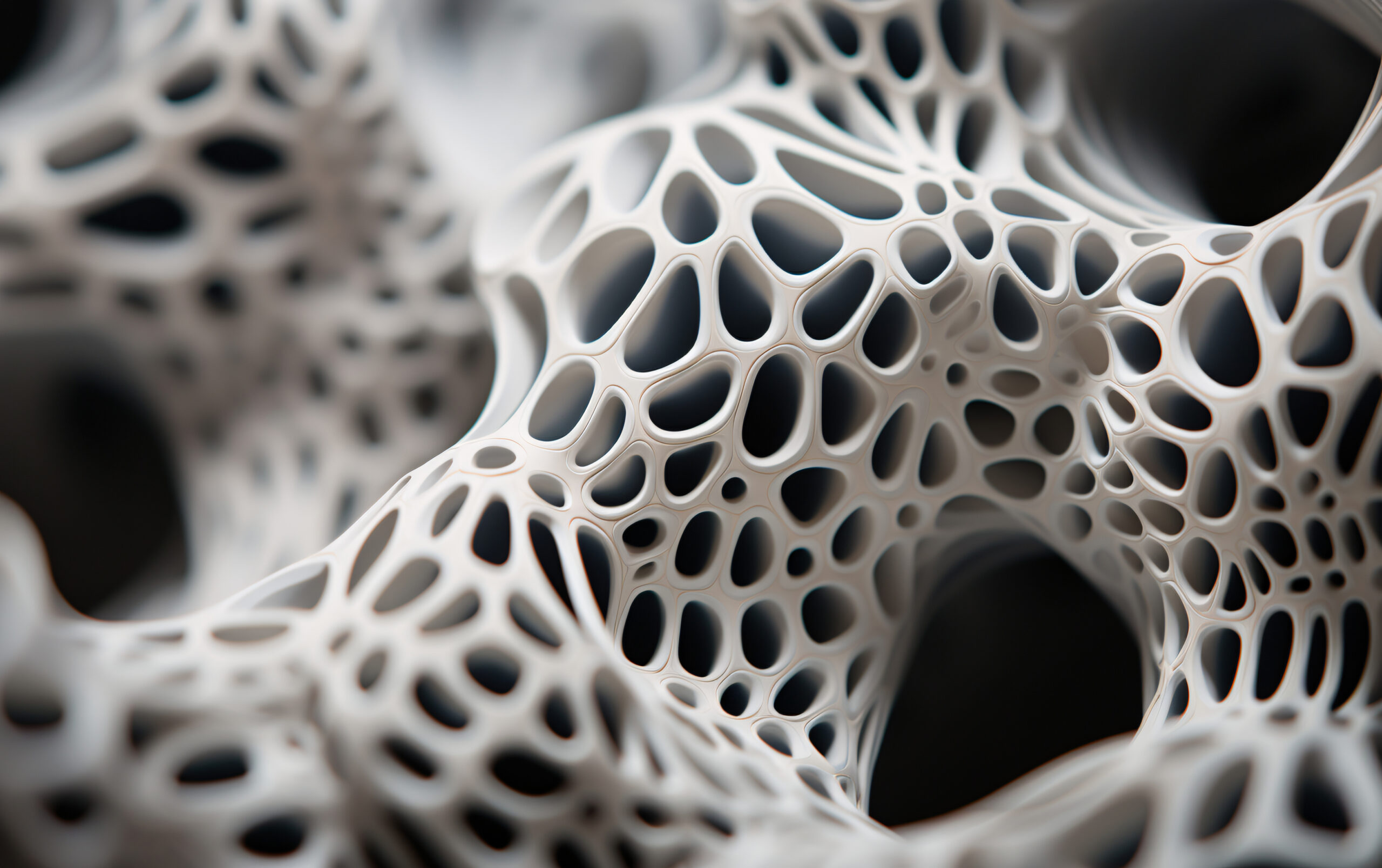
Deformable Body Mechanics: Engineering the Next Generation of 3D-Printed Bone Scaffolds
Bone is not merely a structural support; it is a dynamic, deformable tissue that responds to mechanical stimuli through a process known as mechanotransduction.
In the field of deformable body biomechanics, we move beyond simple movement to analyze how forces cause internal strain and stress within biological materials. For patients suffering from large bone defects, 3D-printed scaffolds offer a promising solution, but their success depends entirely on their ‘mechanocompatibility’—their ability to mimic the elasticity and permeability of natural bone.
Stress Shielding and Elastic Modulus
A primary challenge in orthopedic implants is stress shielding. When an implant is significantly stiffer than the surrounding bone (as is often the case with traditional titanium plates), the bone is ‘shielded’ from its natural load. According to Wolff’s Law, bone that is not loaded will resorb, leading to implant loosening. Deformable body mechanics allows BAB researchers to calculate the optimal porosity of polymer-based scaffolds to match the Young’s modulus of trabecular bone.
The goal is not just to fill a gap, but to create a mechanical environment that whispers to the cells, telling them exactly when and where to grow.
Computational Insights from the BAB Network
Using Finite Element Analysis (FEA), our working groups are simulating how these scaffolds behave under physiological loads. These simulations are complex, requiring the modeling of:
- Non-linear Elasticity: Biological tissues often exhibit hyperelastic behavior, requiring advanced mathematical models.
- Viscoelasticity: Bone scaffolds must handle time-dependent deformation, especially during walking or running cycles.
- Micro-Architecture: The geometry of the pores determines the local strain felt by osteoblasts (bone-forming cells).
Future Directions in Tissue Engineering
The next frontier is the development of 4D-printed scaffolds—materials that change their shape or mechanical properties in response to external triggers like pH levels or magnetic fields. By mastering deformable body mechanics, we are laying the groundwork for truly ‘living’ implants that evolve with the patient.